

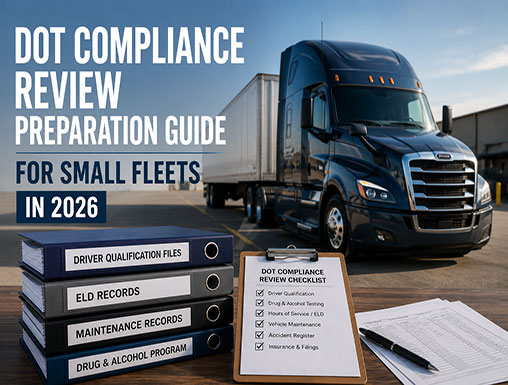
DOT Compliance Review Guide for Small Fleets in 2026
Updated: July 22, 2026 at 11:57 AM
A DOT compliance review is an investigation conducted by the Federal Motor Carrier Safety Administration (FMCSA) to determine whether a motor carrier complies with federal safety regulations. For small fleets, reviews commonly occur during the New Entrant Program, after crash involvement, following repeated roadside inspection violations, or in response to complaints.
Key Takeaways
- A DOT compliance review evaluates whether a motor carrier follows FMCSA safety regulations and maintains effective safety management controls.
- Driver qualification files, medical certificates, annual MVR reviews, and previous employer inquiries are among the most commonly reviewed records during an audit.
- FMCSA auditors often compare ELD (Electronic Logging Device) records against fuel receipts, dispatch records, toll transactions, and bills of lading to identify hours-of-service discrepancies.
- Drug and alcohol testing documentation, Clearinghouse queries, and random testing program records are frequent sources of compliance violations for small fleets.
- Quarterly self-audits can help carriers identify documentation gaps and correct issues before a DOT compliance review occurs.
What a DOT Compliance Review Means for Small Fleets
Auditors examine six broad areas: general carrier operations, driver qualifications, drug and alcohol, hours of service, vehicle maintenance, hazmat (if applicable), and accident records. They are not looking to fail you. They are looking for evidence that your safety management controls actually work in daily operations.
What to do next: Identify which type of review applies to your operation. A new entrant audit follows a different scoring threshold than a compliance review, and knowing which one you face determines how you prepare.
Common Compliance Gaps That Trigger Failed Reviews
Most small fleets do not fail because of one major violation. They fail because of small, repeated documentation gaps that signal a lack of systematic oversight. The pattern is predictable.
The most frequent issues we see include:
- Missing or expired medical examiner certificates in driver files
- No documented pre-employment drug test before a driver’s first dispatch
Incomplete or missing annual MVR reviews
- ELD records that do not match supporting documents like fuel receipts or BOLs
- No proof of annual DOT inspections on power units and trailers
- An accident register that is blank, even when DOT-recordable accidents occurred
- Insurance filings (MCS-90, Form BMC-91) that lapsed or were never updated
Any one of these can lead to acute or critical violations under the FMCSA compliance checklist. Combined, they almost guarantee a Conditional or Unsatisfactory rating.
Takeaway: Build a monthly internal review of these seven items. Catching one missing document a month is far cheaper than fixing a dozen during an audit.
Driver Qualification Files: What Auditors Expect to See
Driver qualification (DQ) files are usually the first records an auditor requests, and they are where many small fleets stumble. Each driver must have a complete file containing:
- Employment application covering the past three years
- Motor vehicle record from each state the driver held a license in (past three years)
- Road test certificate or equivalent CDL acceptance
- Current medical examiner’s certificate and, for CDL holders, proof of National Registry verification
- Annual MVR review and annual driver review of violations
- Previous employer safety performance history inquiries
Files must be updated annually, not just at hire. A common failure point is the annual review: many owner-operators simply forget to pull a fresh MVR every 12 months. Auditors will check dates carefully.
For fleets that find this overwhelming, our DQ file management service maintains every file to current standards so nothing falls through the cracks.
Hours of Service and ELD Records Documentation
Hours of service violations carry significant weight in any trucking compliance review. Auditors typically request six months of ELD data and cross-check it against supporting documents such as fuel purchase records, toll receipts, dispatch records, and customer-signed BOLs.
Three areas draw the most scrutiny:
- Unassigned driving time. Every minute of vehicle movement must be assigned to a driver. Large blocks of unassigned time suggest unlogged driving.
- Personal conveyance use. Misuse of personal conveyance to extend duty time is a top focus area. Document the purpose of each PC event.
- Supporting document matches. If a fuel receipt shows a purchase in Ohio at 3 p.m. but the log shows the driver off-duty in Indiana, that discrepancy will be flagged.
What to do next: Pull a random week of ELD records each month and audit it yourself against fuel and dispatch records. If you cannot reconcile it, neither can the FMCSA.
Vehicle Maintenance and Inspection Recordkeeping
Maintenance records prove that your fleet is roadworthy and that safety defects are addressed. For each vehicle, you must keep:
- An identification record (VIN, make, year, tire size, ownership info)
- A history of inspections, repairs, and maintenance for the past 12 months (retained for 18 months total)
- Annual DOT inspection reports for each power unit and trailer
- Driver vehicle inspection reports (DVIRs) when defects are noted, along with proof of repair
Auditors often ask, “Show me the last 90 days of DVIRs for this truck, and the repair records for any defect noted.” If you cannot produce them within minutes, you have a problem.
Takeaway: Store maintenance records digitally and tag them by VIN. Paper folders in a shop drawer rarely survive an audit cleanly.
Drug and Alcohol Testing Program Requirements
Every motor carrier operating CDL drivers must have a compliant drug and alcohol testing program. Required elements include:
- A written company policy is distributed to every driver with a signed acknowledgment
- Pre-employment drug test results before the driver’s first dispatch
- Enrollment in a random testing consortium with documented selection rates (currently 50% drug, 10% alcohol annually)
- Post-accident, reasonable suspicion, return-to-duty, and follow-up testing procedures
- Clearinghouse queries: pre-employment full queries and annual limited queries for every CDL driver
The FMCSA Drug and Alcohol Clearinghouse is now a primary audit focus. Missing a single annual query for one driver is a recordable violation. Owner-operators who drive their own trucks must still enroll in a consortium and conduct queries on themselves.
What to do next: Confirm your consortium provides annual statistical summaries and Clearinghouse query documentation. You will need both during a motor carrier safety audit.
Accident Register and Insurance Documentation
Every carrier must maintain an accident register for three years. A DOT-recordable accident is one involving a fatality, an injury requiring immediate medical treatment away from the scene, or a vehicle towed from the scene due to disabling damage.
Your register must include the date, city, state, driver name, number of injuries and fatalities, and whether hazardous materials were released. Even if you have had no accidents, you should keep a register clearly marked “no recordable accidents” with the period covered.
Insurance documentation must show continuous coverage at federally required minimums, with current MCS-90 endorsement and active filings on record with the FMCSA. Lapses, even short ones, are flagged immediately.
Building a Pre-Audit Self-Assessment Routine
A reliable self-assessment routine is the single best predictor of a successful small fleet DOT audit outcome. We recommend a quarterly internal review structured around the same areas an auditor examines.
A simple quarterly checklist:
- Month 1: Review every DQ file. Pull fresh MVRs as needed.
- Month 2: Audit a random sample of ELD logs against supporting documents.
- Month 3: Verify maintenance records, DVIRs, and annual inspections are complete; confirm drug and alcohol testing and Clearinghouse queries are current.
Document each review with a brief written summary, including issues found and corrective actions taken. This paper trail itself becomes evidence of effective safety management controls, which auditors weigh heavily.
Takeaway: Auditors reward carriers who can show they actively monitor their own compliance. A binder of self-assessment notes turns a defensive audit into a cooperative conversation.
How We Help Small Fleets Pass DOT Compliance Reviews
DOT compliance review preparation is exactly what we do at FCCR. We work with independent owner-operators and small trucking companies who do not have the staff or time to manage federal paperwork on their own.
Our support includes:
- Dedicated compliance agents who know your operation and respond directly
- Full DQ file setup and ongoing maintenance
- Drug and alcohol program enrollment and Clearinghouse query management
- Annual MCS-150 updates, UCR renewals, and insurance filing coordination
- Step-by-step paperwork guidance whenever a regulation changes
We treat compliance as an ongoing process, not a one-time filing. That is why our clients walk into reviews with organized records, documented procedures, and confidence in their ratings.
Next Steps to Secure Your Fleet’s Compliance Standing
Whether you are facing a new entrant audit, a compliance review, or simply want to stop worrying about FMCSA paperwork, the path forward is the same: get organized, document everything, and build a repeatable review routine.
Three actions to take this week:
- Pull every active driver’s DQ file and check for missing or expired documents.
- Confirm your Clearinghouse queries and drug and alcohol testing records are current.
- Reconcile one week of ELD logs against fuel and dispatch records.
If any of those tasks reveal gaps, or if you simply want a partner to handle compliance from end to end, reach out to us at FCCR. We will help you build a fleet that is ready for any DOT compliance review in 2026 and beyond.
Frequently Asked Questions
A DOT compliance review can take anywhere from a few days to several weeks, depending on the size of the carrier and the complexity of the records being reviewed. Small fleets with organized documentation can usually complete the process more efficiently.
A new entrant safety audit is part of the FMCSA New Entrant Program and typically occurs within a carrier’s first 18 months of operation. A DOT compliance review is a broader investigation that may occur at any time and is often triggered by crashes, inspections, or compliance concerns.
FMCSA auditors commonly request driver qualification files, ELD records, maintenance records, drug and alcohol testing documentation, Clearinghouse queries, accident registers, and proof of insurance filings.
Yes. Owner-operators must meet many of the same FMCSA requirements as larger fleets. Missing documentation, incomplete records, or safety violations can result in compliance issues regardless of fleet size.
Small fleets should regularly review driver qualification files, ELD records, maintenance documentation, drug and alcohol testing records, and insurance filings. Conducting periodic self-audits can help identify problems before an FMCSA review occurs.
Related Articles:
- Understanding the FMCSA New Entrant Safety Audit
- DOT Reinstatement Guide: Reactivate Your USDOT & MC Authority
- MOTUS DOT Registration System Explained

He is the Lead Content Specialist at FCCR, where he develops educational content focused on trucking compliance, DOT regulations, and FMCSA registration requirements. He works closely with compliance processes and industry systems to provide clear, accurate guidance for owner-operators and carriers.