

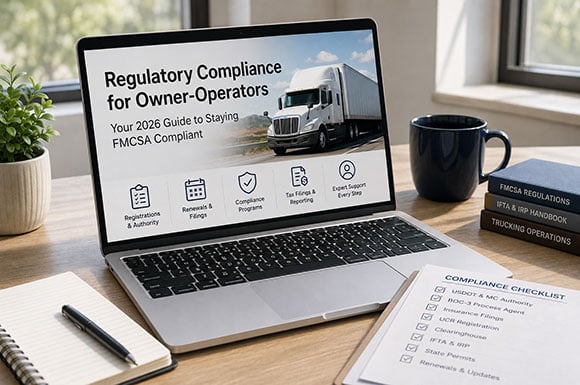
Owner-Operator Compliance Services: Staying FMCSA Compliant in 2026
Updated: August 4, 2026 at 9:51 AM
Regulatory compliance services help owner-operators stay current with FMCSA registrations, annual renewals, tax filings, drug and alcohol testing requirements, and state permits. Rather than tracking dozens of deadlines yourself, a compliance provider manages required filings so you can stay focused on running your business.
The 2026 Compliance Landscape Every Owner-Operator Faces
The good news: owner-operator compliance services exist specifically to take this work off your plate. We help carriers complete federal and state filings accurately the first time so authority stays active and audits stay uneventful.
Here is what defines the 2026 landscape:
- Stricter Motus checks on new MC and USDOT applications
- Continued enforcement of the FMCSA Clearinghouse for all CDL drivers
- Higher attention to BOC-3 process agents and insurance filings (Form MCS-90, BMC-91)
- Ongoing UCR fee adjustments and state-by-state IRP and IFTA scrutiny
Quick takeaway: Treat compliance as a recurring operating function, not a one-time setup task.
Why FMCSA Paperwork Derails New Trucking Businesses
Most owner-operators do not fail because they cannot drive. They fail because a missed filing, a typo on an application, or an unsigned BOC-3 stalls their authority for weeks. During those weeks, trucks sit, loads get cancelled, and payments on equipment keep coming.
Common breakdowns we see include:
- Mismatched legal names between the IRS EIN, state LLC, and FMCSA application
- Incorrect operating classification (motor carrier vs. broker vs. freight forwarder)
- Missed the 21-day protest period after MC publication
- Forgotten New Entrant Safety Audit within the first 12 months
- Insurance filings sent under the wrong docket number
What to do next: Before submitting anything to FMCSA, confirm your legal entity, address, and authority type are identical across every document.
Core Federal Registrations We Handle for Owner-Operators
Federal authority is the foundation of a legal trucking operation. We manage the full registration stack so each piece aligns with the next.
The core filings include:
- USDOT Number filing – Required for any commercial vehicle operating in interstate commerce above applicable weight or passenger thresholds.
- MC Number registration – Operating authority for for-hire carriers transporting regulated commodities. Review the full MC Number requirements before applying so the classification matches your business model.
- BOC-3 Process Agent Designation – Identifies a registered agent in every state for legal service.
- Insurance filings (BMC-91, BMC-34, BMC-84/85) – Submitted by your insurer but verified against your docket.
- Unified Carrier Registration (UCR) – Annual fee tied to fleet size.
Each registration affects the others. A wrong answer on the MCS-150 can change your safety audit timing. An incorrect MC classification can invalidate your insurance filing.
Staying Current: Biennial Updates, UCR, and Annual Filings You Cannot Miss
Getting authority is step one. Keeping it is the harder part. FMCSA deactivates thousands of USDOT numbers every year for missed updates, and reinstating an inactive number can mean lost weeks of revenue.
Key recurring filings:
- MCS-150 Biennial Update (every two years, even if your information has not changed)
- Unified Carrier Registration (UCR) renewal (annually)
- Heavy Vehicle Use Tax (HVUT) Form 2290 (annually)
- International Fuel Tax Agreement (IFTA) quarterly returns
- International Registration Plan (IRP) plate renewals (annually)
- State permit renewals, where applicable
Action step: Set calendar reminders 30 days before each due date. Better yet, hand the calendar to a compliance partner who tracks it for you.
Drug and Alcohol Clearinghouse Requirements and Consortium Enrollment
The FMCSA Clearinghouse is a federal database that tracks drug and alcohol program violations for CDL holders. Every owner-operator who drives under their own authority must:
- Register with the Clearinghouse
- Enroll in a DOT-compliant consortium or third-party administrator (C/TPA) for random testing
- Complete pre-employment queries before any new driver operates
- Run annual queries on every CDL driver, including yourself
Solo owner-operators cannot self-administer random testing. You must belong to a consortium that pulls random selections on your behalf. Missing this requirement is one of the fastest ways to fail a new entrant audit.
We assist with FMCSA Clearinghouse registration and consortium enrollment so testing obligations are met from day one.
State-Level Authority and Permits That Often Get Overlooked
Federal authority does not cover everything. Several states require additional registrations regardless of where your truck is based.
Frequently overlooked items include:
- Kentucky KYU number for vehicles over 59,999 lbs operating in Kentucky
- New Mexico Weight Distance Tax permit
- New York HUT (Highway Use Tax) and decal
- Oregon Weight-Mile Tax account
- Intrastate authority if you also haul loads that never cross state lines
Each state has its own renewal cycle, decals, and reporting forms. Skipping one can mean roadside citations, port-of-entry holds, or back taxes with penalties.
Tax Filings That Keep Your Authority Active: HVUT, IFTA, and IRP
Three filings sit at the intersection of taxes and operating authority. Miss them, and you risk losing plates, decals, or both.
- Heavy Vehicle Use Tax (HVUT) – Form 2290: Filed with the IRS for vehicles 55,000 lbs or more. The stamped Schedule 1 is required to renew IRP plates.
- International Fuel Tax Agreement (IFTA): A quarterly fuel tax return for carriers operating across two or more member jurisdictions. Requires accurate mileage and fuel records per state.
- International Registration Plan (IRP): Apportioned plates for interstate operations, renewed annually based on prior-year mileage by jurisdiction.
Practical tip: Keep fuel receipts and trip records monthly, not quarterly. IFTA audits look back four years, and reconstructing records under pressure is expensive.
Building Your Business the Right Way: LLC, EIN, and BOIR Setup
Authority filings work best when the underlying business is structured correctly. We help owner-operators set up the legal foundation before the FMCSA application is submitted.
Core business setup includes:
- LLC or corporation formation in your home state
- EIN (Employer Identification Number) from the IRS
- Beneficial Ownership Information (BOI) reporting, if applicable under current federal requirements
- Operating agreement and registered agent designation
- Business bank account opened under the legal entity, not your personal name
Filing FMCSA paperwork before the LLC and EIN are finalized is a common source of mismatched records. Sequence matters: entity first, EIN second, then federal authority.
How Our Dedicated Compliance Agents Keep You 100% Road-Ready
Compliance is not a one-time event. It is a calendar of recurring filings, renewals, and audits stretching across federal, state, and tax authorities. Our dedicated compliance agents act as a single point of contact for all of it.
What working with us looks like in practice:
- A direct agent assigned to your account, not a ticket queue
- Filing preparation and review before submission to reduce rejections
- Renewal tracking for MCS-150, UCR, 2290, IFTA, IRP, and state permits
- Clearinghouse query support and consortium coordination
- Plain-language guidance on regulatory changes
We focus on accuracy and timing. The goal is simple: keep your authority active, your records clean, and your trucks moving.
Getting Started With FCCR in 2026
If you are starting a new authority or cleaning up an existing one, the first step is a clear picture of where you stand. We review your current registrations, identify gaps, and build a filing plan that matches your operation.
To get started:
- Call our main line, 208-888-3227, and tell us about your operation
- Get matched with a dedicated compliance agent
- Receive a customized filing checklist for your authority type
- Hand off the paperwork and focus on freight
Regulations will keep changing in 2026 and beyond. With the right compliance partner, that change becomes a manageable workflow instead of a constant risk to your business.

He is the Lead Content Specialist at FCCR, where he develops educational content focused on trucking compliance, DOT regulations, and FMCSA registration requirements. He works closely with compliance processes and industry systems to provide clear, accurate guidance for owner-operators and carriers.